Moving to Aotearoa New Zealand for Cybersecurity Work: A Field Guide for Americans

TL;DR
- This is the worst market in years, and you can still make it work.
- The AI hype has fully landed. It is suppressing hiring and making certain security functions more visibly needed at the same time.
- Kiwis are leaving for Australia in record numbers for higher pay, which thins the experienced pool and leaves gaps you can fill.
- Expect a pay cut. The lifestyle is what makes the trade worth it.
- In-person networking carries the job search. Applications and cold messages do not.
- Seek is the standard job board. LinkedIn counts too, even though Kiwis engage far more quietly than Americans.
- Be physically here, with a visa, or most recruiters will pass on you. Only accredited employers can sponsor you, which narrows the list.
- Lead with breadth. Drop the niche unless the job description is a niche.
- Keep specific US ties open before you leave. Bank, address, business, and ideally a paycheck.
- The shipping and retail world you are used to does not exist here. Adjust early.
- The barriers come from a reasonable place, and they come down. Mine came down in about four months.
The Market Right Now
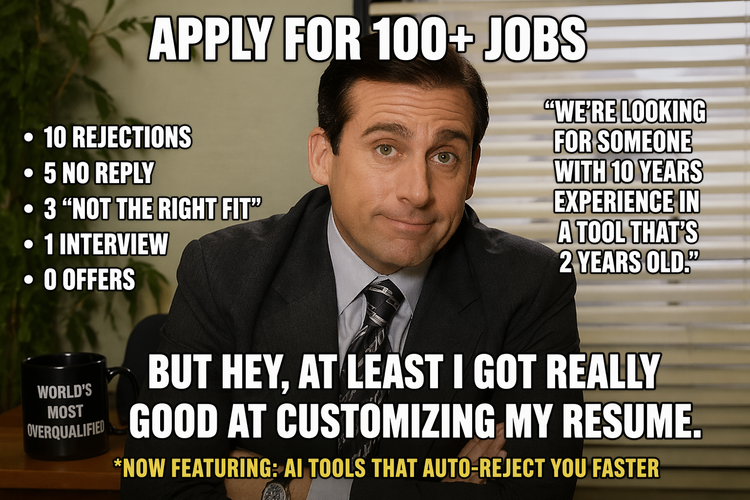
New Zealand spent a long time treating security as a box to tick for the regulators. That is changing. There has been an uptick in major breaches, and the big AI push arrived all at once, and between those two things more people are coming around to the idea that we have to move past box-ticking. That is your opening.
The flip side is the hiring climate. It is genuinely competitive right now. An employer's market means companies can be selective, and they are. The AI hustle has made a lot of teams cautious about headcount even while they talk a big game about transformation.
Add the election year on top of that. Companies get more fiscally conservative heading into an election and tend to sit on their hands until they know the outcome. Budgets freeze, new roles stall, and hiring managers wait to see which way the wind blows before they commit. Factor that into your timing and your patience.
Four months to land a role, with three of those months spent looking and networking, is considered quick here. If it takes you longer, that says nothing about you. The market is just hard right now.
Where AI Is Pointing the Demand
People here wear multiple hats. That is why you see so many "specialist" and "consultant" titles doing five jobs at once. Sell breadth.
I do not want to overstate this, because the market is tight and nobody is hiring freely. What I can say is that the AI push is making certain functions far more visibly needed than they were even a year ago. As organisations rush to layer AI on top of environments that were never fully locked down to begin with, the gaps show up fast. So this is my read, not a guarantee. I expect these areas to grow over the coming months and years:
- Application security (AppSec), securing software and the code it is built from
- Data security and governance
- Identity
- Continuous Threat Exposure Management (CTEM), the ongoing cycle of finding and reducing real exposure rather than running point-in-time scans
A few notes on positioning:
- Do not sell a niche unless the job description is explicitly that niche. Generalists who can flex across the list above fit the way roles are actually scoped here.
- Go easy on the pentest pitch. There is heavy local interest in offensive work, arguably too much of it for a country this size, and I expect it to need fewer bodies over time, not more. Defensive depth plus governance plus identity is the safer bet.
- Frame yourself as risk-led. Protect the Crown Jewels. Bring an adversarial perspective. Prioritise real-world defence and let compliance follow. In a market built on box-ticking, that approach stands out.
The signals that build trust fast, from the hiring side of the table: genuine curiosity, attention to detail, and systematic thinking. Lead with those.
What the Pay Actually Looks Like
You are likely taking a pay cut. New Zealand cyber salaries sit well below what the same role pays in the United States. It is a sizeable gap, and a big part of why Kiwis themselves are leaving for Australia, where the same skills pay more.
Go in with your eyes open. If you are optimising purely for the number on the offer letter, this is the wrong move, and I would rather you knew that now. What makes the maths work is everything around the number. The cost of living, covered further down, balances out more than you expect, and you are buying a different kind of life along with a different job. Read this section and the cost section together. Either one on its own gives you a false picture.
Sorting Your Visa
Before anything else, hire a licensed immigration adviser or an immigration lawyer. I used Aaron Martin at NZ Immigration Law, and it was one of the best calls I made. This is not a place to lean on AI, forum threads, or a friend who did it five years ago. There are plenty of scams and a lot of disinformation in this space, the rules change often, and AI will get much of it wrong because it works from stale or generic information. A good adviser brings current expertise and, just as valuable in a country this small, real connections.
My own pathway is one example among many. I first got a work visa off the back of my wife enrolling in a master's degree at a New Zealand university, which gave me the right to work as her partner. Once I landed a Green List job in my own right, she was able to step out of university. That is one route. There are many others, and which one fits you depends on details only a professional should be assessing.
A few things worth knowing going in, all of which your adviser will confirm and keep current for your situation:
- Only accredited employers can sponsor you. The main work visa is the Accredited Employer Work Visa (AEWV), and a company has to hold accreditation to bring you on. Plenty of organisations that would otherwise want you simply are not set up to sponsor a migrant, which quietly shrinks your target list.
- There is a Green List. New Zealand keeps a list of in-demand roles with faster pathways to residence, and cyber and ICT security roles have featured on it. The list changes, so do not trust any blog, including this one, over a current professional read.
- Residency status changes how you are treated. Until you hold residency you are classified as "casual," which colours how some employers see you.
Sort the visa pathway first, with a professional, and the rest of the search gets much simpler.
Clearances and Government Roles
If you are coming out of US government or military work, set your expectations here. Your US security clearance does not transfer. It buys you nothing on paper the day you land. In theory the Five Eyes partnership between New Zealand, the US, the UK, Canada, and Australia should count for something, and a shared-intelligence heritage is worth a mention. In practice I have not seen it carry much weight lately, though I could be wrong on that.
Beyond that, a lot of New Zealand government roles, the national agencies like the GCSB (Government Communications Security Bureau) and the NZSIS (New Zealand Security Intelligence Service), and parts of critical infrastructure require New Zealand citizenship or residency, and are effectively closed to recent arrivals. So the obvious-looking path, where your federal or defence background opens government doors the way it might back home, mostly does not exist at the start. I say this as someone with an Air Force background who assumed otherwise.
The private sector does not weigh clearances the same way, and that is where your near-term path is. Banks, insurers, telcos, consultancies, and the like will value the experience behind the clearance even though the clearance itself does not carry over. Aim there first, get residency in motion, and the government doors can come later if you want them.
The Regional Picture
A caveat first. My own experience is Auckland and Hamilton, so treat the rest of this as general orientation rather than lived detail. Where you aim changes the size and the flavour of the market.
- Auckland is the largest commercial market by a distance. Banks, insurers, big corporates, and the consultancies cluster here, and so does the bulk of private-sector cyber work. If you want the widest pool of roles, this is it.
- Wellington is the seat of government. Public sector, policy, and the national agencies live here, so it is the hub if you are drawn to government or policy-flavoured cyber. Keep in mind the citizenship and residency gates from the section above, which bite hardest in exactly this part of the market.
- Christchurch has an active tech and hacker scene, which is part of why CHCon calls it home, along with some government and aerospace presence. Smaller than Auckland, but far from sleepy.
- Hamilton, where I landed, is a smaller market with fewer roles, but a tight community and an easier on-ramp than fighting the Auckland crowd from day one.
Auckland for breadth, Wellington for government, and the smaller centres for community and a softer landing.
Networking Is the Whole Game
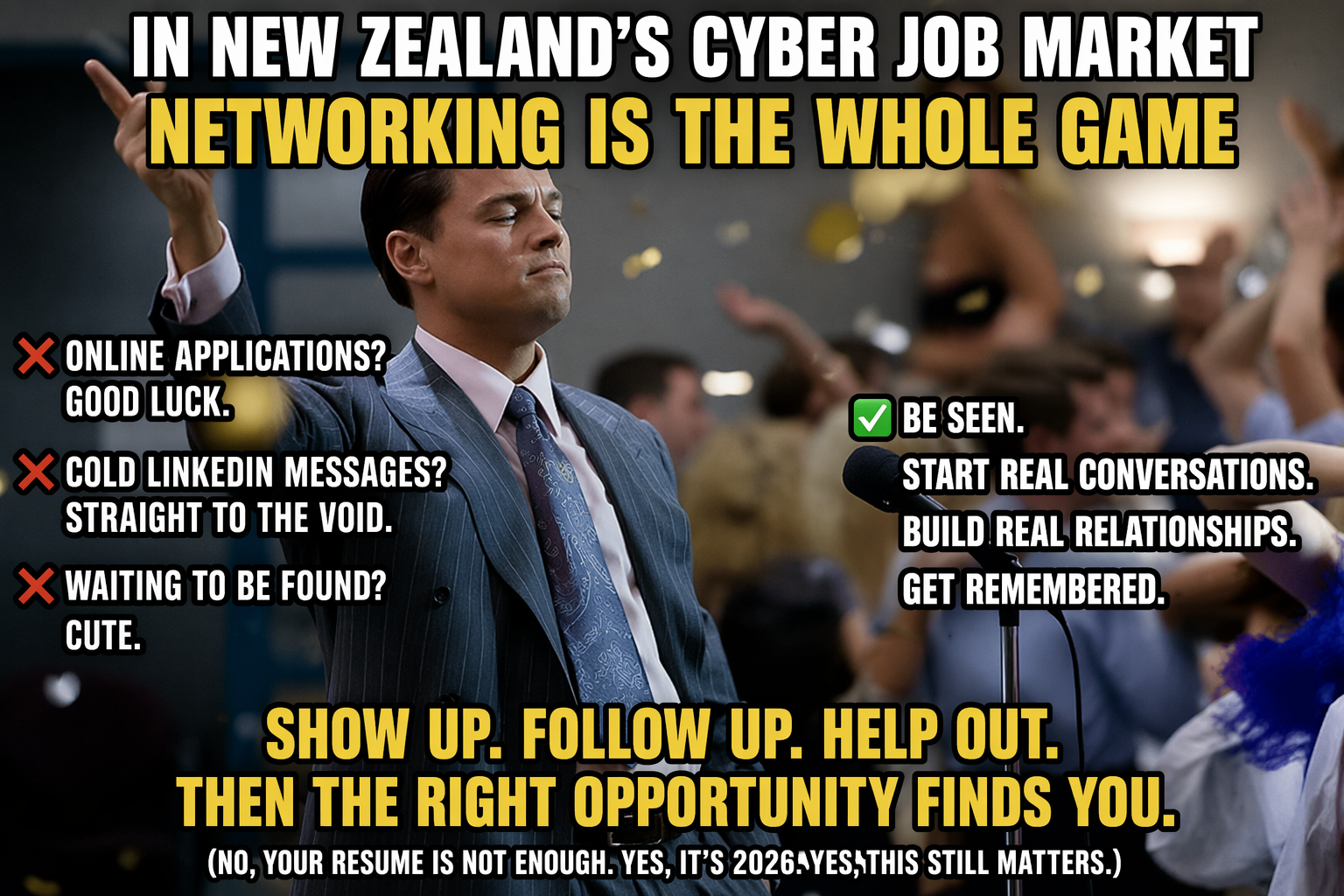
Professional networking is the foundation the whole job search sits on. The real networking happens in person and in private. This is a small country, everyone is about two degrees of separation from everyone else, and the people at the top of this field all know each other.
When I was job hunting I interviewed at two organisations, and the place I ended up was the second. What I did not know at the time was that the two CISOs (the Chief Information Security Officers at each place) knew each other, and they had talked about me between themselves, including their own plans for where I might fit. Decisions about my future were being made in a conversation I was not in, by people who trusted each other's read over my CV. Your reputation arrives in the room before you do, and it travels through quiet back channels you will never see.
So treat every coffee, every meetup, every conference hallway chat as part of one long conversation. The person you have a good chat with today may be the reason a door opens six months from now.
Here is where I have plugged in, and what each one is good for:
- ISIG (Information Security Interest Group). Local chapters with regular in-person meetups. I spoke at the Hamilton ISIG chapter, and it was a few nights at these meetups that turned into a standing invite to an invitation-only whisky club. This is the ground floor of the in-person network. Start here. Chapter details circulate through the community and LinkedIn rather than one fixed page, so ask locally for the next one.
- InfoSecNZ on Discord. A lively online forum for sharing local challenges and keeping a finger on the pulse between events. Invite links move around, so grab the current one at a meetup or from a local contact.
- CHCon (Christchurch Hacker Conference). One of the cornerstone hacker cons. I have presented and compared notes here.
- Kawaiicon. The Wellington hacker con with a strong community feel, successor to the long-running Kiwicon.
- NZITF (New Zealand Internet Task Force). A non-profit, trust-based forum for the national security community, with an annual conference.
- OWASP New Zealand Chapter. Application security meetups across Auckland, Hamilton, Christchurch, and Wellington.
- OWASP New Zealand Day / AppSec NZ. The annual application security conference in Auckland. Code-level lessons and a lot of front-of-mind talk about AI's impact on development.
- CISO Leaders Summit NZ. Where the senior leaders who talk about you behind the scenes gather. Strategy, governance, board-level security.
- CISO New Zealand (Corinium). A second senior leadership gathering worth knowing if you are working the management camp.
- Summer of Tech. A charity running workshops and internships that connect newcomers and students to local tech employers. A good entry point if you are early-career or new on the ground.
- A note on ITP NZ. IT Professionals New Zealand has since closed down. I was a paying member and it was a useful professional anchor while it lasted, so if you come across it referenced in older posts of mine or anywhere else, know that it is no longer an option. Put your membership energy into the groups above instead.
Read the Two Camps
The scene here splits into two camps, and they do not mix as much as you would think.
On one side is the technical community. ISIG, InfoSecNZ, Kawaiicon, and CHCon are full of deeply technical people, and a lot of them have no interest in management and not much patience for it. They want to do the work, go deep, and be left alone to be good at it. Management can feel like the thing that gets in their way.
On the other side is the leadership world. The CISO Leaders Summit and cons of that flavour are full of management, strategy, and governance, with a lot less hands-on tech in the room. The conversations are about budgets, board reporting, and risk posture.
That gap is an opportunity, and it is where I found my niche while wearing many hats. There is an abundance of pentesters, red teamers, and hackers here. What I have seen far less of is people who can tell a full, holistic story between the technical floor and senior management. Someone who can sit with the engineers, understand what they are actually seeing, and then carry that up to the executive table in language that lands.
The clearest time this paid off for me was selling a security strategy to Mac, one of our senior leaders. I will keep the specifics out of this. What made it land was the translation, more than the technical depth on its own. Taking what the technical reality demanded and putting it in terms a senior leader could act on and champion. It landed well, and it stuck. If you are a technical person who can lead, or a leader who never lost the technical thread, that bridge is wide open. Position yourself there and you become hard to replace.
So work both camps. Show up at the hacker cons to keep your technical credibility current, and show up where the leaders gather so they know your name. The value is in being one of the few who is welcome in both rooms.
Go to the conferences. Have the coffees. Keep turning up. The people in these circles remember who showed up and who was easy to talk to. The tone is polite and curious. People ask collaborative questions rather than the gotcha kind you might brace for from the States. It is a calmer way to operate, and worth slowing down for.
Job Boards and LinkedIn
Networking carries most of the load, and you still need to know where roles get posted. Seek (seek.co.nz) is the standard job board here. It is the first place to look, where most cyber roles go up, and the one recruiters and employers default to. Check it daily.
LinkedIn still counts, and this is where Americans misread the room. Kiwis are not as loud as we are. They will not like, comment, or repost the way you are used to, and the quiet can feel like nobody is paying attention. They are. I can see from my own site analytics that people click through and read even when a post gets almost no public engagement. They are forming a view of you without ever tapping a button. So keep posting and keep showing up. Your audience is bigger and more attentive than the like count suggests.
Recruiters
Recruiters are necessary. They hold a lot of the keys, they each have their own relationships and ways of working, and they talk to each other in private channels, even competitors.
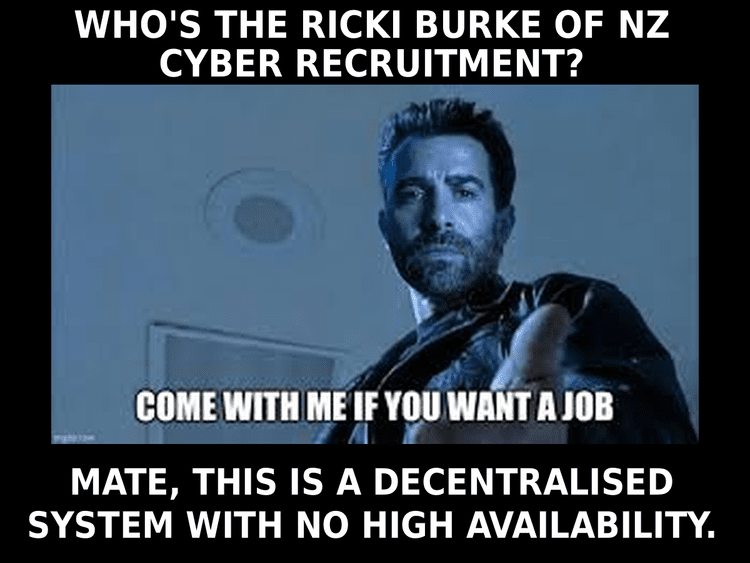
There is no Ricki Burke of NZ, no single recognised cyber recruiter who anchors the whole market the way he does across the ditch. You cannot find the one person and let them carry you. Work with several, build a relationship with each, and accept that they all operate a little differently. Spread your bets.
The harder part: most recruiters will not work with you unless you already have both a work visa and are physically here to meet for a coffee. Both, not one. The market is tight and they do not have the bandwidth to manage aspirations from the other side of the planet. Try not to take it personally. They are surviving the same market you are trying to enter.
The companies behind them face the same pull. This is an employer's market, and many have policies that require them to show they tried to hire locally before moving to a foreign candidate. So even a strong fit can stall while a business works through its local-first obligations. It is the order of operations here, nothing personal. Being on the ground, visa in hand, ready to grab a coffee, is what moves you from aspiration to candidate. If you can get here, get here.
The Local Experience Barrier
Expect to hear some version of "you do not have New Zealand experience yet." Sometimes it is literal. Often it is code for foreigner. In my case it cost me an extra round, all the way up to the CDTO, the Chief Digital and Technology Officer.
Meet it with some grace. From where they sit it is a fair instinct. They have watched people arrive, struggle to adapt, and leave, and a small market feels every bad hire. The hesitation is about familiarity and risk, not your worth.
A few things to hold at once:
- It is about familiarity, not your capability.
- It can be steeper for black and brown candidates, and there is a baseline anti-American bias to read around. That is a heavier load for some of us than others, and worth naming plainly.
- Skills plus a clear willingness to adapt do eventually outweigh the lack of local experience. You have to break the barrier first, and the soft market makes that harder, but people do it.
Your CV, Not Your Resume
The American one-page resume does not translate here, and clinging to it is one of the quieter reasons good candidates get passed over. The format is different, the length is different, and the mindset behind it is the most different of all.
I learned this the hard way. Early on, with my US resume, I got critical feedback from several recruiters. Not about my experience, about the document. It was not landing. Once I rebuilt it into a properly localised New Zealand CV, the feedback flipped. The same recruiters who had been lukewarm came back positive, and so did new ones I had not spoken to before. Same career, same person, different document.
The core of it: they do not care about your chores. They care about your stories. A US resume tends to be a tight list of duties, the things you were assigned to do. A New Zealand CV wants the narrative underneath that, what the situation was, what you did, and what changed because you did it. Less "responsible for incident response," more "led the response to a ransomware case that had taken out endpoint visibility, reconstructed the attack path from firewall and switch logs, and got the business back online." Same fact, told as a story with you at the centre of it.
The workflow that worked for me:
- I paid CV People NZ to do the translation. They did a far better job than AI could, because they know the local format, the expectations, and the unwritten rules in a way no template or model does. We did several interviews together to get it right. Worth every dollar.
- I used AI to brain-dump first. Before working with them I had an AI tool interview me, role by role, asking pointed questions about specific projects. That pulled out stories I would never have thought to list. I turned all of it into a single "everything.docx," a giant raw dump of detail, and handed that to CV People as raw material. The AI gathered the material. The humans shaped it into something that works here.
A few more notes:
- Go longer than you would at home. Two or three pages is normal and expected.
- Open with a short personal profile. A few lines on who you are and what you bring, written like a human, sets the tone.
- Lead every role with outcomes, not tasks. Tell the story of what you changed, ideally with a result attached.
- A bit of personality is welcome. Interests and a sense of who you are off the clock are normal here, and they feed the relationship-based trust the culture runs on.
Get this right and you stop reading as a foreigner who pasted in an American resume, and start reading as someone who understands how things work here.
Money and Legal Ties to Keep in the US
The ones nobody warns you about until it is too late.
- Keep a US bank account open that is not tied to any credit cards. You will still want a clean US-dollar rail.
- Keep a US address if you can. A real home address, not a virtual mailbox. And do not tell any US company you are moving out of the country.
- Keep your US business entity even if you plan to open one in New Zealand. Getting a Kiwi business to carry indemnity insurance that covers the US is near impossible and unaffordable, because the US is seen as high risk to underwrite.
- Hold onto a US job if you can, for as long as you can. I will be straight that this one sits in a grey area. Keeping a US role while you relocate can mean being less than fully honest with that employer about where you are and what you are doing, and I am not going to dress that up as clean. What I will say is that a few months of US paychecks landing while you find your feet would have made an enormous difference for me, and I wish I had protected that income longer. One practical catch: New Zealand runs roughly eighteen to twenty hours ahead of the US mainland, so keeping a US job in real time means working nights. Weigh the ethics and the sleep yourself. The gap between leaving one paycheck and earning the next is wider than you expect.
- Your credit history resets to zero. None of your US score comes with you. That affects renting, getting a post-pay phone plan, and any future mortgage. Build local history early and expect to feel like a teenager again for a while.
- Start banking early once you arrive. Opening an account takes time, and they will want identity verification, your US banking history, and local compliance steps worked through.
US Taxes Still Apply After You Move

This one surprises people, so plan for it before you go. The United States taxes its citizens on worldwide income no matter where they live. Moving to New Zealand does not end your US filing. You keep filing every year, on top of your New Zealand tax.
A few things to get ahead of:
- Foreign account and asset reporting. Once your overseas balances cross certain thresholds, you have to report them to the US government under the FBAR (Foreign Bank Account Report) and FATCA (Foreign Account Tax Compliance Act) rules. The penalties for missing this are steep, and "I did not know" is not much of a defence.
- The KiwiSaver trap. KiwiSaver and many New Zealand managed funds can be treated as a PFIC (Passive Foreign Investment Company) under US tax rules, which turns a normal retirement contribution into a genuine tax headache. Get advice before you enrol in anything, not after.
- Get a cross-border accountant. Someone who knows both systems and the treaty between them is close to mandatory. The mechanisms to stop you being taxed twice exist, but you have to file correctly to use them.
This should not stop you from coming. It should push you to budget for a specialist and set things up right the first time.
Shopping and Shipping on an Island
This one caught me off guard, so let me save you the surprise. The convenient logistics machine you grew up with does not exist here. We are on an island at the bottom of the South Pacific, and the supply chain reflects that every day.
There is no two-day shipping norm. Prime spoiled all of us, and you have to unlearn it. Ordering something online and having it turn up in a week is normal and fine. Importing anything gets expensive fast once freight and duties land on top of the price. Amazon Australia exists and will ship some things across, and the cost of doing that from New Zealand often makes it not worth it. Plan ahead, buy local where you can, and let go of the idea that anything you want is two clicks and 48 hours away.
Where people actually shop:
- PB Tech. Computers, components, networking gear, general tech. If you are in this field you will end up here. Prices on imported tech run higher than US equivalents, so brace for that.
- The Warehouse. The big red shed. General everything store, household goods, basics, cheap and cheerful. The local all-purpose stop.
- Kmart. Forget the American picture in your head. Kmart in the US is a sad, fading memory. Kmart here is owned by the Australian side and it is genuinely good. Clean, busy, well stocked, cheap homeware and clothing and kids' gear that people rave about. One of the first places locals will send you to kit out a house. Do not skip it because of the name.
- The supermarket duopoly. Groceries are dominated by two players. Foodstuffs runs New World and Pak'nSave, and Woolworths runs the stores that used to be Countdown. That is basically it. The lack of competition is a live national grievance, and it shows up in your weekly shop. Pak'nSave is the budget end if you are watching the bill.
A couple of extras. Trade Me is the local institution for buying and selling almost anything, secondhand cars and furniture included, so it is worth a login early. Mighty Ape covers a lot of the online-order gap for games, gadgets, and homeware. Once you reset your expectations, it all works. You just have to stop waiting for the world to arrive overnight.
Setting Up After You Land
The practical stuff that trips up Americans:
- No driving test to convert your licence. You can convert your US licence without sitting a test. One catch: bring proof that you have held your US licence for more than two years, because if the licence itself does not state that, you will need separate documentation to show it.
- Health insurance is optional for most people. Public healthcare covers a lot, and unless your visa conditions require it, you may not need health insurance at all. What private insurance adds here is extra protection, faster access to some services, and a few perks on top. It is not mandatory or necessary for most people, so do not assume you have to buy it the way you did back home. The bigger shift is how ordinary care feels. A medication that would have cost me around US$1,400 a month in the States came to roughly NZ$460 here, sorted in a single conversation with my GP, no insurer and no fight.
- Houses are cold and damp. New Zealand homes are famously under-insulated, often with no central heating. Winter indoors can be a shock. Budget for heat pumps, a dehumidifier, and warm bedding, and check insulation before you sign a lease.
- Sort housing before you arrive. Most rentals are run by property managers rather than the owner directly, and much like the recruiters, they are split across the market with their own relationships and ways of working. You build rapport with several of them, not just one. They will do FaceTime and Zoom tours. Expect several to ghost you before one comes through. You cannot turn on utilities until you are physically present, so budget for a few motel nights when you land.
- Expect to buy appliances. Most people here take their appliances with them when they leave a rental, so a place can come with empty spaces where the fridge, microwave, and laundry should be. Be ready to kit it out yourself, used on Trade Me or Facebook Marketplace or new from the local stores. Budget for a fridge, a washing machine, a microwave, and the rest from day one.
- The cost of living, and how it balances out. Petrol sits around NZ$3.40 a litre, and yes, it stings. Here is the shift in thinking though. Once your wages are in New Zealand dollars, the US-to-NZ conversion stops being something you do in your head. NZD is the only currency that counts at the pump, the checkout, and on payday, so you stop converting and live in the local economy. Some things cost more, like fuel and groceries. Others swing hard the other way. No tipping culture, childcare far cheaper than the States, healthcare mostly sorted, and a whole system built around wellbeing over convenience. Add it up and it balances out, and it softens the pay cut more than the raw numbers suggest. Stop converting everything back to dollars and you will settle faster.
- Paperwork on arrival: an IRD number (Inland Revenue Department, New Zealand's tax authority, the local equivalent of a Social Security number for tax), new phone numbers, and a bank account. Without permanent residency you are classified as "casual," so know your visa pathway.
Answering "Why New Zealand"
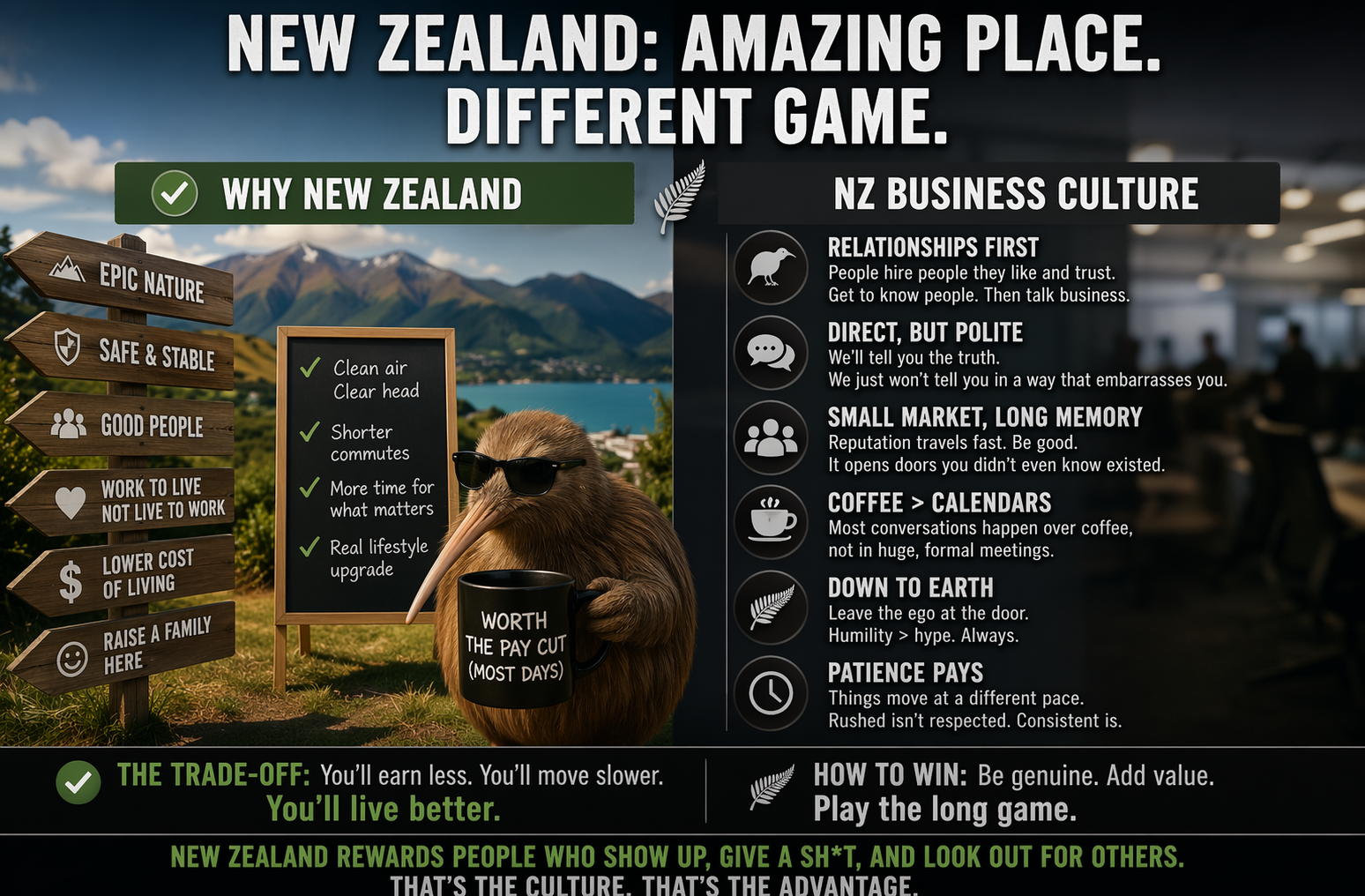
Have your answer ready before you arrive, because you will be asked everywhere you go. Not just in interviews. At meetups, over coffee, at the school gate, at the barbecue. Why New Zealand, why here, why leave the USA. Sometimes the same people will ask more than once, months apart. It can feel like a test you keep re-sitting, and in a way it is.
Frame your answer around moving toward something rather than running from something. Clean air, accessible healthcare, good education, a culture worth respecting. Keep it about what you are coming to. That lands far better here than a list of grievances about home.
Two things are usually going on when people ask. Part of it is genuine curiosity, because an American choosing to move here is still novel enough to be interesting. Part of it, especially in an election year, is a quiet way of working out where you sit politically, specifically whether you are MAGA. People here are deeply read-in but do not talk politics openly. They skirt around it and feel you out sideways. So treat the question as both a friendly icebreaker and a values check. Answer it warmly, answer it consistently, and let your "toward" story do the work.
The deeper point is one of mindset, and it goes well beyond the interview. The posture clearly preferred here belongs to someone who came to contribute and build. To add to the place, put down roots, and give something back, rather than someone running from a fire at home. Both kinds of people end up on the same plane, and locals can feel the difference fast. Carry the builder's mindset into every conversation, mean it, and let your work become the proof. That is the version of an American this country wants more of.
New Zealand Business Culture: A Culture Map Read
If you want one framework to orient yourself, use Erin Meyer's Culture Map. It plots cultures on eight behavioural scales, and the useful part for us is that the United States sits at the far end of several of them while New Zealand sits somewhere quite different. Knowing the gap saves you from misreading the room. The ones worth knowing:
- Deciding leans consensus over top-down. Decisions get made by bringing the group along, talking it through, and landing on something everyone can live with. It feels slower than what you are used to. Walking in and driving to a fast call, even a good one, reads as steamrolling. Build the consensus and the decision holds. Force it and it quietly unravels later.
- Communication runs more indirect than home. Americans are about as say-it-plainly as it gets. Kiwis leave more meaning in what is not said, in tone and understatement. Listen for the gap between the words and the intent, and do not assume that silence in a meeting means agreement.
- Negative feedback comes softened. Criticism tends to be gentle and wrapped in politeness. "Yeah, that could work, might be worth thinking about another option" is often a no. If you wait for blunt American-style feedback, you will miss the message. Learn to hear the soft version.
- Leadership is egalitarian and flat. Titles get downplayed, the boss acts more like a facilitator than a commander, and pulling rank lands badly. Influence comes from being respected rather than from your seat at the table.
- Disagreement avoids open confrontation. Public, heated debate is uncomfortable here in a way it is not in some US rooms. Raise the hard thing gently, often one-on-one, before it reaches a group setting.
- Trust leans relational. People want to know you before they fully back you. That is why the coffees and meetups and the whisky club carry so much weight. Competence opens the door, and the relationship gets you trusted with the real work.
Underneath all of it is a collective, community-minded streak, deepened by te ao Māori, that values the group over the standout individual. The practical translation for an American: slow down, consult widely, soften your edges, read the unspoken, and let trust build over time. Do that and the same culture that felt closed starts working with you.
Fitting In
This is the part I would underline twice.
Dial down the American energy. I say that with love, because I had to learn it myself. The volume, the speed, the certainty, the habit of filling every silence. It can come across as rude here even when you mean well. The pace is calmer, and people leave room in a conversation on purpose. Slowing down reads as respect.
The biggest adjustment is this. There are a lot of sharp, critical thinkers here, more per capita than I was used to, and they are very aware of what is going on in the world. They follow US politics, global supply chains, the wars, the tech industry, often more closely than the people I knew back home. There is no need to explain the state of the world to them, and no need to warn them about it. They already know. Coming in to brief people on things they have tracked for years lands badly and fast. Ask questions. Listen more than you broadcast. Assume the room is informed, because it usually is.
Tall Poppy Syndrome
There is a name for one cultural thing you will bump into, and knowing it going in helps. Tall poppy syndrome is the local habit of cutting down people who stand too tall, who self-promote, who broadcast their own achievements. In the States that kind of self-marketing is normal and often rewarded. Here it gets you quietly pruned. Lead with resume-on-a-billboard energy and you will lose the room. Let your work speak, let others surface your wins, and stay humble about what you bring. Confidence is welcome. Loud self-celebration is not. It is one of the fastest ways to read as "too American," and one of the easiest to fix.
A few more things that helped me:
- Learn the small vocabulary swaps. Plaster instead of band-aid, trainers instead of sneakers. Little signals of respect.
- Learn some te ao Māori and the pepeha tradition. It is woven into everyday life here, including your kids' kindy if you bring family. Approach it as a guest who is still learning, because that is what you are.
- Drop the trauma-dumping. Save the firehose of American stress for your closest people once you have earned the closeness. Early on it is a lot to put on someone.
- You will be told Kiwis are friendly but impossible to befriend. That does not have to be your story. A few ISIG meetups turned into a standing invite to an invitation-only whisky club for me. Show up consistently, stay humble, and the doors open wider than you were warned they would.
Family and Schooling
If you are bringing kids, the schooling here is one of the best parts of the move, and it works very differently from the United States. Children get to be children. The early academic pressure that feels normal back home is largely absent. My daughter is about to start primary school and will not be bringing home any homework. The early years lean communal and play-based, learning together rather than cramming facts to pass a test. It is a calmer, healthier on-ramp into education, and it shaped our decision as much as anything on the work side.
Early childhood is supported too. Kindy and daycare are subsidised by the government, with schemes like 20 Hours ECE that take a meaningful chunk out of the cost for young children. The rules and thresholds change, so check the current entitlements, but the headline is that childcare here costs far less than what we had braced for at US prices.
Why Make the Move
It is the hardest market in years, and the foreigner barrier will test you. It still came down for me in about four months, on reputation and on showing up in person, into a country waking up from compliance theatre into real security investment. The brain-drain to Australia leaves gaps. The AI wave is making the work I care about more visibly needed, and a broad American defender can step into that. Add clean air, healthcare that treats care as ordinary, and kids putting down roots in a culture worth respecting, and the maths holds even with the pay cut.
It is hard. What you get on the other side is worth the work. People do this, and you can be one of them, as long as you arrive ready to prove yourself on the ground and willing to come as a learner rather than an expert on a place you have not lived yet.
I will leave you with one final meme on the AI situation. Good luck!